
Modern industries face increasingly complex surface preparation challenges. Traditional cleaning methods struggle to meet demands for precision, environmental compliance and substrate protection simultaneously. Laser technology addresses these requirements through a single adaptable platform that serves diverse sectors without compromise.
Surface contamination affects every industry differently. Manufacturing requires pristine substrates for coating adhesion. Aerospace demands meticulous cleanliness without material alteration. Heritage conservation needs gentle treatment that preserves irreplaceable surfaces. Laser cleaning adapts to each application through parameter adjustment rather than method substitution.
This technological versatility transforms how Wellington businesses approach surface treatment across industrial, commercial and specialised applications. One system handles countless challenges that previously required multiple cleaning methods, equipment investments and operational protocols.
Universal Technology for Diverse Industrial Requirements
Traditional surface preparation methods serve narrow application ranges. Sandblasting works for heavy rust but damages delicate components. Chemical stripping removes coatings effectively but contaminates substrates. Mechanical abrasion cleans aggressively but alters dimensional tolerances.
Laser cleaning transcends these limitations through fundamental operational differences. No physical contact occurs between equipment and workpiece. No chemical reactions introduce residues or require neutralisation. No abrasive media embeds into porous materials or creates disposal obligations.
Adjustable parameters accommodate varying contamination types, substrate materials and cleanliness requirements. Power density, pulse duration, repetition frequency and scanning velocity all modify according to specific needs. This adaptability enables applications ranging from nanometre-scale electronics cleaning to square-metre heritage facade restoration.
Manufacturing and Fabrication Sector Applications
Production efficiency depends heavily on surface preparation quality. Welding requires oxide-free metal for strong joints. Coating systems demand chemically clean substrates for optimal adhesion. Assembly processes need residue-free components for reliable bonding.
Laser cleaning eliminates oxides, cutting fluids, drawing compounds and machining residues without introducing new contaminants. Metal surfaces emerge chemically pristine and ready for immediate processing. This direct workflow eliminates intermediate cleaning stages that extend production timelines.
Manufacturing applications include:
✓ Weld preparation on stainless steel, aluminium and exotic alloys
✓ Paint removal before refinishing or coating application
✓ Mould cleaning for plastics injection and compression processes
✓ Degreasing precision components before assembly
✓ Oxide removal from heat-treated parts
✓ Surface activation before adhesive bonding
Fabrication workshops gain competitive advantages through faster turnaround times and reduced defect rates. Dimensional tolerances remain unchanged throughout cleaning operations. Surface finishes preserve their engineered characteristics whilst contaminants disappear completely.
Quality control becomes straightforward when cleaning results prove consistent and repeatable. Operator skill requirements decrease because parameter settings determine outcomes rather than manual technique variations.
Automotive Industry Solutions
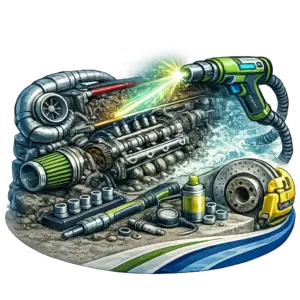
Vehicle maintenance and restoration present unique surface preparation challenges. Rust develops on chassis components and body panels. Paint systems deteriorate and require removal. Engine assemblies accumulate carbon deposits and oil residues.
Traditional automotive cleaning methods create secondary problems. Sanding generates dust contamination. Chemical strippers attack rubber seals and electrical components. Media blasting warps thin panels through impact forces.
Laser cleaning serves automotive applications including:
✓ Corrosion removal from undercarriage components
✓ Paint stripping without panel distortion
✓ Engine block cleaning before reconditioning
✓ Brake calliper restoration
✓ Injection mould maintenance
✓ Weld preparation on structural repairs
Classic vehicle restoration benefits particularly from non-contact processing. Original panels clean without thickness reduction or surface texture changes. Chrome plating survives rust removal intact. Delicate trim components restore without mechanical stress.
Modern repair facilities use laser technology for accident damage correction. Frame straightening proceeds more accurately on clean metal. Corrosion repair achieves superior coating adhesion. Aluminium body panel work avoids cross-contamination from steel abrasives.
Workshop productivity improves through elimination of masking, containment and cleanup activities associated with chemical or abrasive methods. Technicians work faster whilst achieving better quality outcomes.
Aerospace and Defence Applications
Aviation safety depends absolutely on component integrity. Surface treatments must remove contamination without introducing stress risers, dimensional changes or material property alterations. Even microscopic damage proves unacceptable in flight-critical applications.
Laser cleaning meets aerospace industry requirements through precise, controllable energy delivery. Thermal barrier coatings lift cleanly from turbine blades. Corrosion disappears from landing gear assemblies. Adhesive residues remove from composite structures. All without substrate harm.
Aerospace sector applications include:
✓ Aircraft component inspection preparation
✓ Thermal coating removal before reapplication
✓ Corrosion treatment on aluminium airframes
✓ Composite surface preparation for bonding
✓ Engine component cleaning during overhaul
✓ Foreign object debris elimination from critical assemblies
Defence applications value the elimination of abrasive media contamination risks. Traditional grit blasting leaves particles embedded in threaded fasteners, hydraulic components and electronic housings. These particles cause premature wear or catastrophic failure during operation.
Laser processing produces no foreign object debris. Components emerge completely clean without introduced contaminants. This operational safety advantage proves particularly valuable in mission-critical equipment maintenance.
Non-destructive testing proceeds more reliably on laser-cleaned surfaces. Crack detection, thickness measurement and material inspection all achieve better accuracy when contaminants and coatings no longer obscure base materials.
Heritage Conservation and Restoration
Cultural preservation demands cleaning methods that respect original materials whilst removing harmful accumulations. Centuries of pollution, biological growth and previous inappropriate treatments often obscure historic surfaces.
Laser technology allows conservators to work with unprecedented control and selectivity. Stone facades clean without erosion. Timber beams restore without scorching. Metal sculptures emerge from corrosion without patina loss. Painted surfaces reveal beneath overpainting without original layer damage.
Conservation applications include:
✓ Building facade cleaning on sandstone, limestone and marble
✓ Graffiti removal from heritage structures
✓ Sculpture restoration on bronze, copper and iron
✓ Painted surface uncovering through selective layer removal
✓ Timber beam cleaning in historic buildings
✓ Archaeological artefact preparation for study
Wellington’s heritage buildings benefit from cleaning methods that preserve architectural character whilst removing deterioration. Victorian ironwork restores without grinding damage. Art Deco facades clean without sandblasting erosion. War memorials refresh without inscription wear.
Museum professionals value the gentleness that allows treatment of irreplaceable items. Laser parameters adjust down to sensitivity levels appropriate for delicate artefacts whilst remaining effective on robust structural elements.
Documentation quality improves when surfaces are properly clean. Photography, photogrammetry and condition assessment all achieve better results on contamination-free substrates.
Electronics and Semiconductor Manufacturing
Microelectronics fabrication requires contamination control at molecular scales. Traditional wet cleaning introduces moisture risks. Mechanical methods generate static discharge. Chemical processes leave residues that interfere with subsequent processing steps.
Laser cleaning operates dry and generates minimal particulate. Precision focusing allows treatment of individual circuit traces without affecting adjacent components. Controlled energy input prevents thermal damage to temperature-sensitive materials.
Electronics applications include:
✓ Circuit board cleaning before conformal coating
✓ Semiconductor wafer surface preparation
✓ Lead frame oxide removal
✓ Solder mask residue elimination
✓ Connector contact cleaning
✓ Microchip encapsulation preparation
Cleanroom compatibility makes laser systems ideal for high-purity manufacturing environments. No abrasive media introduces contamination. No chemical vapours compromise air quality. Equipment operates within existing environmental controls without special accommodation.
Production yields improve when substrates arrive at subsequent processes in optimal condition. Bonding failures decrease. Coating adhesion strengthens. Component reliability increases throughout product lifecycles.
Oil, Gas and Energy Sector Maintenance
Power generation and hydrocarbon processing equipment operates under extreme conditions that accelerate surface deterioration. Scale accumulates on heat exchangers. Corrosion attacks pipeline infrastructure. Thermal coatings degrade on turbine components.
Maintenance windows are costly in continuous-process industries. Every hour of downtime represents substantial revenue loss. Cleaning methods that work quickly whilst equipment remains installed deliver significant operational advantages.
Energy sector applications include:
✓ Turbine blade coating removal and reapplication preparation
✓ Heat exchanger tube cleaning
✓ Pipeline valve refurbishment
✓ Pressure vessel internal surface treatment
✓ Compressor component maintenance
✓ Steam generator tube sheet cleaning
Portable laser systems deploy directly to installation sites. Offshore platforms, remote pumping stations and confined industrial spaces all accommodate equipment that traditional methods cannot reach effectively. On-site treatment eliminates transportation costs and schedule extensions.
Precision cleaning preserves engineered surface finishes that influence operational efficiency. Turbine blade profiles maintain aerodynamic characteristics. Heat transfer surfaces retain designed texture. Critical tolerances survive cleaning without degradation.
Strategic Advantages Across All Applications
Industries adopting laser cleaning technology gain multiple competitive benefits. Processing speeds exceed traditional methods substantially. Environmental compliance simplifies through elimination of hazardous materials. Workplace safety improves through reduced chemical and dust exposure.
Capital investment recovers quickly through operational savings. Consumable costs drop to negligible levels. Labour requirements decrease. Rework frequencies decline. Quality consistency improves. These factors combine to deliver measurable return on investment across diverse applications.
Wellington businesses serving multiple industries benefit particularly from technology versatility. Single equipment investment serves varied customer needs. Capability expansion occurs through parameter development rather than additional machinery acquisition.
The transition from traditional cleaning methods to laser technology represents strategic positioning for future requirements. Regulatory pressures continue tightening around chemical usage and waste generation. Customer expectations for quality and turnaround keep rising. Laser cleaning addresses both trends simultaneously.
Surface preparation quality influences every subsequent manufacturing, maintenance or restoration process. Coating longevity, weld integrity, component reliability and aesthetic outcomes all depend on proper substrate condition. Laser technology delivers the foundation that ensures optimal results across industrial applications.
References
Environmental Protection Authority New Zealand – Hazardous substance regulations and environmental compliance frameworks governing traditional cleaning methods and waste disposal.
https://www.epa.govt.nz/
Standards New Zealand – Technical specifications for surface preparation, coating systems, welding procedures and quality assurance across multiple industrial sectors.
https://www.standards.govt.nz/
WorkSafe New Zealand – Occupational health and safety requirements for industrial cleaning operations, chemical handling and workplace hazard management protocols.
https://www.worksafe.govt.nz/
Heritage New Zealand Pouhere Taonga – Conservation guidelines and best practice frameworks for heritage building maintenance and artefact restoration.
https://www.heritage.org.nz/
Civil Aviation Authority of New Zealand – Aircraft maintenance standards, component inspection requirements and approved cleaning methods for aviation applications.
https://www.aviation.govt.nz/
New Zealand Transport Agency – Vehicle safety standards and automotive repair specifications relevant to structural component treatment and restoration.
https://www.nzta.govt.nz/